Marine Alliance for Science and Technology for Scotland

Fisheries Science Forum

Welcome to the MASTS Fisheries Science Forum

This Forum is a world-class fisheries science collective which provides research and advice relevant to sustainable fisheries management. By focusing on the ecology, economics, sociology, and governance of commercially exploited marine fish and fisheries, this Forum intends to improve our understanding of marine [fish & shellfish] systems, and the human [fisheries] influence on them.

News & Events

General

Forum Activities

Open Forum Sessions

MASTS Open Forum Sessions aim at connecting the MASTS community with its diverse Research Forums and Steering Groups. At these online sessions, Forums “open their doors” to present their members’ work, network with the community and exchange ideas on Forum objectives and activities.

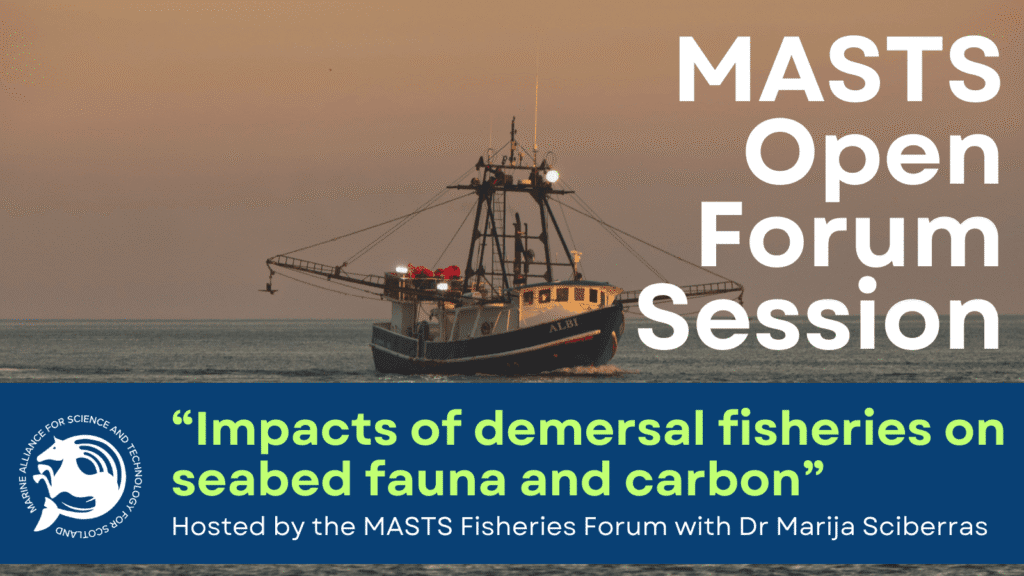
“Impacts of demersal fisheries on seabed fauna and carbon” (2025)

A recording of this session is available on the MASTS YouTube Channel. Speaker: MASTS Fisheries Forum member Marija Sciberras, Heriot-Watt University.

“Spatial Squeeze in Fisheries” (2024)

Basis for this session was a report by NFFO & SFF on the mounting concerns within the fishing industry across the UK about the loss of fishing grounds to an array of competing spatial pressures. This sessionb was not recorded. Speakers:

  • Dr Tania Mendo (FISMaDiM project, Fisheries Sensitivity Mapping and Displacement Modelling)
  • Arina Motova-Surmava (Spatial Data Mining Tool in Seafish’s Tableau, Spatial Fishing Data Mining Tool Seafish),
  • Matthew Frow (Kingfisher Bulletin App, Infrastructure Files for use on vessels, FishSAFE, KIS-ORCA, Fishing restriction mapping, UK wide mapping of gear-based fishing restriction byelaws)


Conferences & MASTS Representation
2024: Fisheries Science Forum representing MASTS at Scottish Parliament Roundtable

Professor of Fisheries Michel Kaiser represented MASTS and gave evidence at a meeting of The Scottish Parliament Rural Affairs and Island Committee last week.
He sat alongside other leading experts to discuss the state of Scotland’s marine science sector and suggested ways in which it can flourish for the benefit of fishers, researchers and the Scottish economy.

For more information please read the full meeting report and watch the meeting online here.

Forum Resources

The Committee held a roundtable evidence session on 26 Oct 2022, including stakeholders from both the fishing & environmental sectors, designed to support the Committee’s understanding of key issues affecting Scotland’s inshore fisheries. The Committee will use this evidence to inform its future work programme. More information here.

A newly published scientific report highlights the potential for a sustainable razor clam fishery in Scotland. The study looked at evidence from an ongoing trial of electrofishing for razor clams. It adds to the evidence base around razor clams and fishing practices and will inform any future policy decisions and potential fisheries management measures.

The razor clam electrofishing trial began in 2018 and is currently authorised until the end of January 2025. Conducted in partnership with the Health and Safety Executive and Food Standards Scotland, the trial brings together scientists, policy makers, compliance officers and the fishing industry. Participating vessels contribute to scientific research, following the trial’s terms and conditions, and have an exemption from a ban on fishing and landing razor clams in Scotland.

The fishing method involves inshore fishing vessels slowing pulling electrodes over the seabed to draw out burrowed razor clams, which are then collected by hand. This has a lower impact on the marine environment than alternative methods such as dredging. A sustainable razor clam fishery could bring economic and social benefits to coastal communities. Razors worth approximately £6.1 million were caught as part of the trial in the year ending 31 January 2022. Scottish razor clams are considered a delicacy in many parts of the world, particularly in far eastern markets.

>>> Please access the report here. 

>>> A data dashboard is also available here. 

This event provided the opportunity to showcase to Marine Scotland Policy colleagues, the scope and research expertise relevant to fisheries across the MASTS community. The symposium was designed to allow a broad selection of research to be highlighted through a series of brief presentations and time for questions and discussion.
Policy colleagues were invited to participate in a facilitated open discussion to explore how the research community can engage and help to better inform policy.  The facilitator for this event was Kara Brydson, Executive Director at Fisheries Innovation & Sustainability.

A copy of the abstract booklet and links to selected presentations is available to view here.

2020: ECR and PhD Fisheries Science Conference (2020)

On the 15th and 16th January 2020, the Lyell Centre and Heriot-Watt University hosted a conference for PhD and early career fisheries and conservation scientists, organised by the MASTS Fisheries Forum. This was the first such conference that the FSF had sponsored and it was hosted by Professor Michel Kaiser who joined HWU in February 2019.
One of the aims of MASTS is to ensure that Scottish HEIs punch above their weight, so the conference was an excellent opportunity for the fisheries community to get together and share their research findings, ambitions and ideas. Thirty students and researchers attended from Orkney, Oban, Stirling, Edinburgh, St Andrews, Strathclyde, and Aberdeen. There were 25 PhD and ECR presentations, covering all types of fisheries, with topics as wide ranging as fisheries acoustics (counting cod in Greenland), to parasite infections in scampi in The Clyde, to environmental effects of ghost-fishing. The workshop had two keynotes speakers; Aoife Martin from Seafish who spoke about her experience of managing fisheries in New Zealand, and David Donnan from Nature Scotland (formerly SNH) who spoke about the importance of science in implementing conservation policy. The conference concluded with a social media and communication workshop run by Michel Kaiser and Dr Heidi Burdett (both based in The Lyell Centre). MASTS kindly sponsored the catering for the event.

2019: Special Session at the MASTS Annual Science Meeting

This Forum hosted a special session at the 2019 ASM on “The future of Scottish fisheries in a changing world”.

2015 Publication with contribution from Forum members: “A review of Scotland’s marine fisheries: stock status, knowledge gaps, research requirements and stakeholder engagement”

Alyson Little, Nick Bailey, Robin Cook, Clive Fox, Hazel Curtis, Michael Heath, Tara Marshall, Beth Mouat, Paul Fernandes.
Please find the publication here.

FIS – Fisheries Innovation & Sustainability

A coalition of experts driving innovation for the UK seafood industry with a focus on Smartrawl (AI-aided precision fishing system), decarbonising fishing vessels and digitalisation.


Forum Objectives

The MASTS Fisheries Science Forum aims to be a world-class fisheries science collective which provides research and advice relevant to sustainable fisheries management. The Forum works under the MASTS ‘Productive Seas’ Theme to improve our understanding of marine [fish and shellfish] systems, and the human [fisheries] influence on them, by undertaking research into the ecology, economics, sociology, and governance of commercially exploited marine fish and fisheries. This is important not only for the long term economic future of an important global industry, but for the well-being of rural communities, and the food security and good health of the general public.
The forum will complement and supplement work carried out by national agencies such as Marine Scotland, but focus on medium to long-term strategic research, although members may provide short-term objective scientific advice on fisheries matters, as well as expert opinion & comment. The Forum will use and develop innovative technology and tools in support of these goals, drawing on the broader range of expertise available in the Scottish HEI community and the Scottish fishing industry. Finally, the forum will help to develop a new generation of fisheries scientists, providing a vibrant research atmosphere and training opportunities for young scientists.

This Forum works closely with Fisheries Innovation & Sustainability (formerly known as Fisheries Innovation Scotland). Find out more here. Download “A review of Scotland’s marine fisheries: stock status, knowledge gaps, research requirements and stakeholder engagement” here.

  • Interacting with the different communities which have an interest in Fisheries.
  • Engaging with new partners and promoting collaboration across disciplines to further Fisheries research.
  • Ensuring greater output and providing databases for those interested in Fisheries Science.
  • Discussing and helping to deliver the best scientific knowledge available.
A box full of just caught mackerel fish

Forum Steering Group

Forum Convenor:
Paul Fernandes (
Heriot-Watt University)

Professor | Global Research Institutes & The Lyell Centre

Interests:

  • Sustainable management of marine resources
  • Development of advanced underwater survey technologies (acoustics, visual surveys, geostatistics)
Shaun Fraser (UHI/University of the Highlands & Islands)

Senior Scientist and Fisheries Lead

Interests:

  • Acoustic Investigation of the Hydrodynamics and Ecology of a Tidal Channel and the Impacts of a Marine Renewable Energy Installation
  • Fishing gear technology, hydroacoustics, stock assessment, inshore fish populations, and marine renewable energy
Arina Motova-Surmava (Seafish)

Chief Economist

Interests:

  • Data collection, fisheries and natural resource management, bio-economic modelling, international relations and trade
  • International economics
Beth Mouat (UHI/University of the Highlands & Islands Shetland)

Director of Research, Enterprise & Impact

Interests:

  • Research and development work in the fields of fisheries, marine spatial planning and aquaculture
Mike Heath (University of Strathclyde)

Marine Biology and Oceanography

Interests:

  • Mathematical and statistical modelling of fish populations and fisheries, and the dynamics of ecosystems
  • Population dynamics of zooplankton in the North Atlantic, impacts of aquaculture nutrient release on the environment, impacts of climate change on fisheries, and latterly on human and climate impacts on indices of ecosystem status
Tania Mendo (University of St Andrews)

Lecturer School of Geography and Sustainable Development

Interests:

  • Interdisciplinary approach to achieving effective management of small-scale coastal fisheries
  • Research that informs policy and focuses on the development of methods and indicators to secure a just space for small-scale fishers in the blue economy
  • Development and incorporation of socio-economic indicators to adequately represent the contribution of small-scale fishers for employment, poverty alleviation, and food security and in developing statistical methods to adequately represent fishers use of marine space
Robin Cook (University of Strathclyde)

Senior Research Fellow Mathematics and Statistics | Fish stock assessment scientist

Interests:

  • Stock assessment models which can be used to quantify seal-fishery interactions and address issues of discarding at sea
Clive Fox (UHI-SAMS/University of the Highlands & Islands – Scottish Association for Marine Science)

Senior Lecturer Fisheries Ecology

Interests:

  • Research, teaching and consultancy related to fisheries and aquaculture
  • Discarding and habitat impacts; Controls upon the population dynamics of marine finfish;
  • Large-scale patterns in the distribution of the fish eggs and larvae and zooplankton in relation to oceanography;
  • Environmental and biological controls on the growth and survival of fish through the egg, larval and juvenile stages; Impacts of climate change on marine finfish; Development of indicators for use in ecosystem-based management;
  • Interactions between the environment and aquaculture and recently broader issues around marine planning and strategy
Douglas Speirs (University of Strathclyde)

Reader Mathematics & Statistics

Interests:

  • Developing computationally efficient population models of fish stocks in which physiological structure and spatial structure and combined
  • Modelling the growth and transport by ocean currents of stage-structured populations
Elena Balestri (Scottish Fishermen’s Federation)

Senior Fisheries Policy and Science Manager

Interests:

  • Natural Resource Management, Marine Biology, Fisheries Management, Policy and Science
  • Translating complex scientific concepts into pragmatic guidance for policymakers and fishers
Harriet Cole (Marine Directorate, Scottish Government)

Fish Polulation Modeller

Interests:

  • Applied marine and fisheries ecology
  • Marine and coastal resource management
Karen Diele (Edinburgh Napier University)

Professor of Marine Ecology | Head of the Centre for Conservation and Restoration Science (CCRS)

Interests:

  • Dynamics, management and conservation/restoration of coastal ecosystems, on the life cycles and functional ecology of associated benthic marine invertebrates and their behavioural and physiological responses to environmental change (e.g. underwater noise, climatic stressors)
  • Mangrove forests, seagrass meadows, rocky shores and biogenic reefs
  • Descriptive and experimental field and laboratory studies to answer fundamental biological and ecological questions and to deliver conservation, management and livelihood solutions
Marija Sciberras (Heriot-Watt University)

The Lyell Centre

Interests:

  • Sustainable resource management, blue economy and marine conservation, and focuses on gaining an understanding of the effects of anthropogenic activities on marine ecosystems, their functioning and resilience
  • Employing diverse methods such as offshore and coastal surveys, laboratory experiments, and evidence synthesis techniques to quantify the impact of human activities on marine life and ecosystems and to study the effectiveness of different natural resource sustainability and management tools
  • Understanding and sustainably managing marine benthic communities, which offer valuable ecosystem services, is essential for preserving these crucial natural resources
Mark James (University of St Andrews)

Operations Director (MASTS)

Interests:

  • Fisheries and aquaculture
  • Marine renewables and biogenic reefs
Michel Kaiser (Heriot-Watt University)

Co-Director of the Lyell Centre | Professor of Fisheries Conservation

Interests:

  • Topics at the interface between human impacts on the marine environment and conservation, with a particular emphasis on developing techniques to minimize ecological impacts of fisheries and aquaculture, and research to underpin the appropriate use of marine protected areas
  • Recovery and dispersal dynamics in seabed communities and integration of social and economic valuation of marine biodiversity
  • Research informing international and national fishing and conservation policies and work with the seafood industry to find technological solutions that will improve sustainable practices.
Jasmine Freeman (University of Strathclyde)

PhD student in Marine Ecology 

Interests

  • Ecological consequences of climate driven changes on marine phenology 
  • The cues and sensitivities behind phenological processes 
  • Mathematical and statistical modelling of ecosystem dynamics
Secret Link
MASTS Resources

We’re working behind the scenes to bring you a suite of useful, and updateable, resources including: 

  • Find an expert
  • Find facilities & equipment
  • MASTS Publications


If you would like to be updated when the resources section is live please let us know.