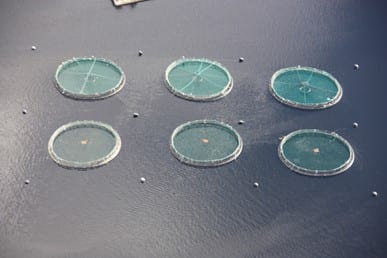
This Forum is focusing on promoting sustainable supply from the Scottish aquaculture sector. It provides research and advice relevant to developing sustainable aquaculture and encompasses the entirety of the Scottish aquaculture sector, including fin-fish, invertebrates and algae.
MASTS Open Forum Sessions aim at connecting the MASTS community with its diverse Research Forums and Steering Groups. At these online sessions, Forums “open their doors” to present their members’ work, network with the community and exchange ideas on Forum objectives and activities.
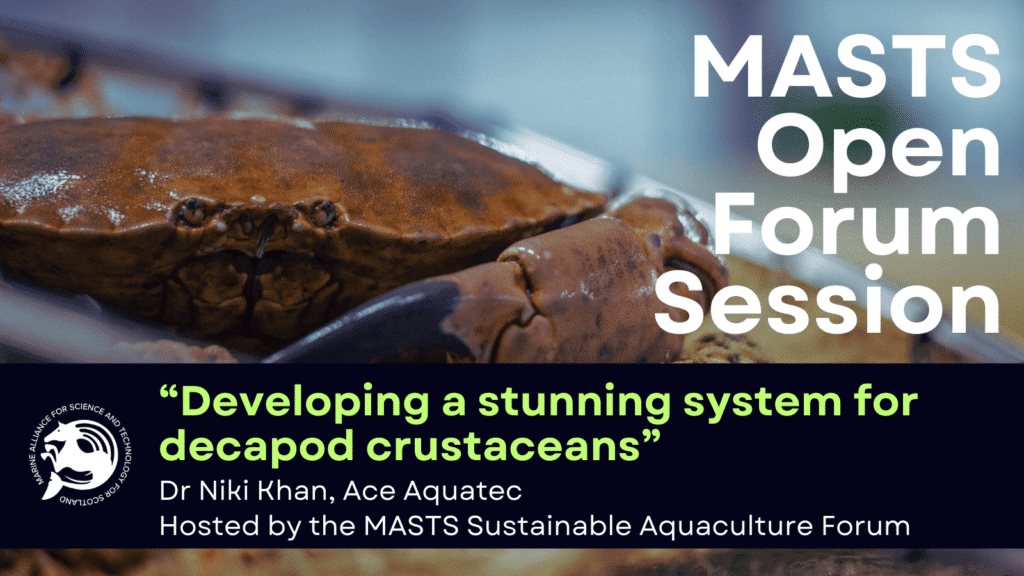
“Developing a stunning system for decapod crustaceans” (2025)
Dr Niki Khan (Ace Aquatec, Dundee, UK) is giving an insight into the challenges of introducing more humane methods to killing decapod crustaceans and introduces the development of a small scale, portable stunner.
Speaker: Dr. Niki Khan, Lead Bioscientist, Ace Aquatec
Since 2022, decapod crustaceans, such as crabs, lobsters, and prawns, have been recognised by UK legislation as ‘sentient beings’. Despite this, there has been little movement on industry regulations, and decapod crustaceans are often treated in extreme ways. For example, most are killed by suffocation, chilling, or by boiling- methods that would be unthinkable for terrestrial species.
Change is currently being driven by consumers, and supermarkets have accepted this change in public attitudes with increasing bias towards producers that adopt welfare focused practices, such as electrical stunning. For producers that adopt this practice shift there is increased market access. However, the majority of decapod production originates from small-scale businesses, and these producers risk being locked out of the global market due to the cost and access to electrical stunning equipment.
Large-scale electrical stunners exist, and on the other end of the scale, is the Crustastun, where a single individual is stunned at a time. These are useful in very different scenarios; either large scale production, or individual processing such as that seen in restaurants. However, currently, there are no ‘in between’ solutions- something that can stun more than one individual at a time, but doesn’t require a multi-tonne throughput.
Here, I will discuss the development of a small scale, portable, in-water electrical stunner with a 20kg batch capacity. This would be a valuable opportunity to also discuss further practical applications of such a stunner, as well as design considerations.
“Innovative Photocatalytic Barrier for Targeted Elimination of Harmful Algal Blooms in Salmon Farms” (2025)
A recording of this Session is available on the MASTS YouTube Channel! Dr Menezes and Dr Souza Moura (Robert Gordon University) describe the innovative use of LED to influence Harmful Algal Blooms.
Speakers: Dr Indira Menezes and Dr Diana Souza Moura (Robert Gordon University)
Harmful algal blooms (HABs) can cause significant loss of farmed salmon, particularly through gill damage and oxygen depletion. Advanced oxidation processes have shown promise in eliminating algae due to generation of radicals with high oxidative power. Photocatalysis is one type of advanced oxidation process which has the significant advantage that it can destroy algae and toxic metabolites by using a catalyst and low-cost LEDs without the addition of chemicals.
A highly innovative addition to photocatalysis is to explore the use of LED to influence the phototaxis of HABs by selecting the correct wavelength of LED to provide targeted elimination of HABs before they reach salmon cages. Targeted highly localised treatment minimises the impact on non-target organisms while efficiently removing HABs before adverse effects occur. The aim of this project is to design a highly efficient photocatalytic barrier to protect salmon cages from HABs with minimum impact on natural biota, by applying novel LED lure lights for targeted photocatalytic destruction of HAB species identified as hazards in salmon aquaculture.
(2025)
The MASTS ASM is a cross-disciplinary event that brings together the marine science community, with the aim of promoting and communicating research excellence and forging new collaborations. The event includes expert plenary speakers, general science and panel sessions, and e-posters.
Please see here for an overview of previous ASMs and programmes.
The Forum organised both a Special Session on “Sea Lice Surveillance and Modelling” and Workshop on “Innovations in Sea Lice Monitoring”. The Workshop was organised by Dr Helena Reinhardy (SAMS-UHI) and Dr Thangavel Thevar (University of Aberdeen) and well-attended with about 40 participants. The Session was co-chaired by Dr Sandy Murray (Marine Directorate, Scottish Government) and Dr Helena Reinhardy (SAMS-UHI), with a total of 7 talks.
Please see the full programme here.
Special Session talks:
Evgenia Micha & Ingrid Kelling, published 29 March 2025 in Nature npj Ocean Sustainability >>> Please click here to read the article
Micha, E., Kelling, I. Understanding fishers’ wellbeing through participatory processes in fisheries management. npj Ocean Sustain 4, 10 (2025). https://doi.org/10.1038/s44183-025-00107-8
Soon to be available
DOI : 10.1007/s40152-025-00431-2
The latest issue of The Grower is now available at https://www.assg.org.uk/ and includes:
Published after a MASTS ASM 2022 Workshop on EDI in Scottish Aquaculture by Ingrid Kelling and Ibrahim Lawan (2023).
Read the paper here!
The pace and scale of aquaculture development in Scotland has been accompanied and underpinned by the growth of world leading aquaculture research expertise in our Universities and research institutes, many of whom have been at the heart of European and wider international efforts to develop sustainable aquaculture.
The forum encompasses the entirety of the Scottish aquaculture sector, including fin-fish, invertebrates and algae. Multidisciplinary research is critical to support the ecological, social and economic aims of the aquaculture industry, and MASTS is working with the industry to achieve these aims.
Scotland has been proactive in developing a robust and effective policy and regulatory framework for aquaculture. MASTS research contributes through helping reduce the losses related to disease and parasites, diversifying marine fish and algae production, managing and genetically improving farmed species, replacing and reducing marine ingredients within aquafeeds, site design including contained production systems and colocation with marine renewables development, and ensuring a sustainable and ethical supply of food for the future.
Global Research Institutes & The Lyell Centre | Co-Chair of Fish+ Panel
Interests:
Reader | School of Biology
Interests:
Senior Lecturer in Sustainable Aquaculture
Interests:
School of Energy, Geoscience, Infrastructure and Society
Interests:
School of Biodiversity, One Health & Veterinary Medicine
Interests:
Business Development Manager
Interests:
Institute of Aquaculture, University of Stirling
Interests:
Aquaculture Manager
Interests:
Aquaculture and Environment Group Leader
Interests:
Head of Aquaculture Development
Interests:
Prof | Food Security & Diagnostics | Institute for Global Food Security | School of Biological Sciences
Interests:
Research Director
Interests:
Marine Biotechnology
Interests:
Functional molecular biologist and biochemist
Interests:
Lecturer in Aquatic Environmental Science
Interests:
Director of Research, School of Biological Sciences
Interests:
We’re working behind the scenes to bring you a suite of useful, and updateable, resources including:
If you would like to be updated when the resources section is live please let us know.