This Forum promotes research, monitoring, training and an enhanced understanding of the effects of environmental (single or preferably multiple) stressors, both natural and anthropogenic, on aquatic organisms and communities. Investigations into stressor impacts range from empirical through to restoration and governance perspectives. The Forum is a centre for dialogue and networking and offers expertise, collaboration and advice.
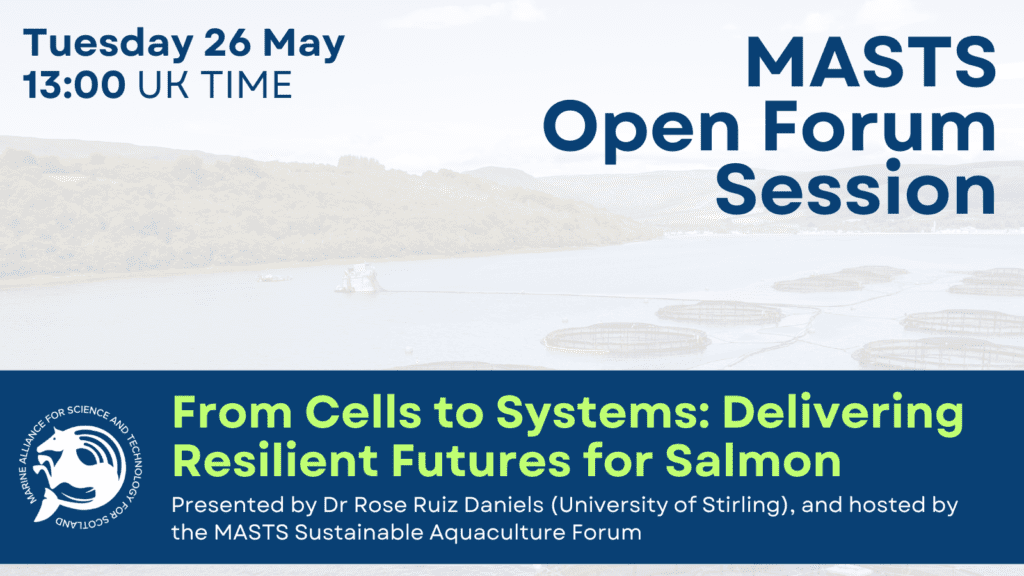
MASTS Open Forum Sessions aim at connecting the MASTS community with its diverse Research Forums and Steering Groups. At these online sessions, Forums “open their doors” to present their members’ work, network with the community and exchange ideas on Forum objectives and activities.
A recording of this session is available on the MASTS YouTube Channel! Dr Beric Gilbert (University of the West of Scotland) describes the complexity of multi-stressor and species-specific dynamics.
Speaker: Dr Beric M. Gilbert (University of the West of Scotland)
Aquatic ecosystems are subjected to anthropogenic pollutants. Conventional monitoring techniques often lack the sensitivity required to detect changes before severe consequences occur. This creates a critical need for innovative, rapid and highly sensitive detection methods to safeguard aquatic ecosystem health. Organisms have been effectively incorporated and utilised in biomonitoring approaches to provide information about the types and levels of toxicants entering environments, as well as the duration of exposure. Of the various taxa utilised, parasites have attracting increased attention in this regard due to their species-, toxicant-, and environment-specific responses to different pollutants. Contrary to their typically negative connotation in human and animal health contexts, parasites exhibit complex ecological interactions that can be leveraged as sensitive bioindicators. Ectoparasites, which infect the outer surfaces of their hosts have further benefits given that in some cases they can be removed from the host without the need of euthanising the host. Additionally, to this, their sensitivity to environmental change, host and macroenvironment, position them as valuable bioindicators. However, the complexity of multi-stressor and species-specific dynamics necessitates novel approaches to their use as bioindicators.
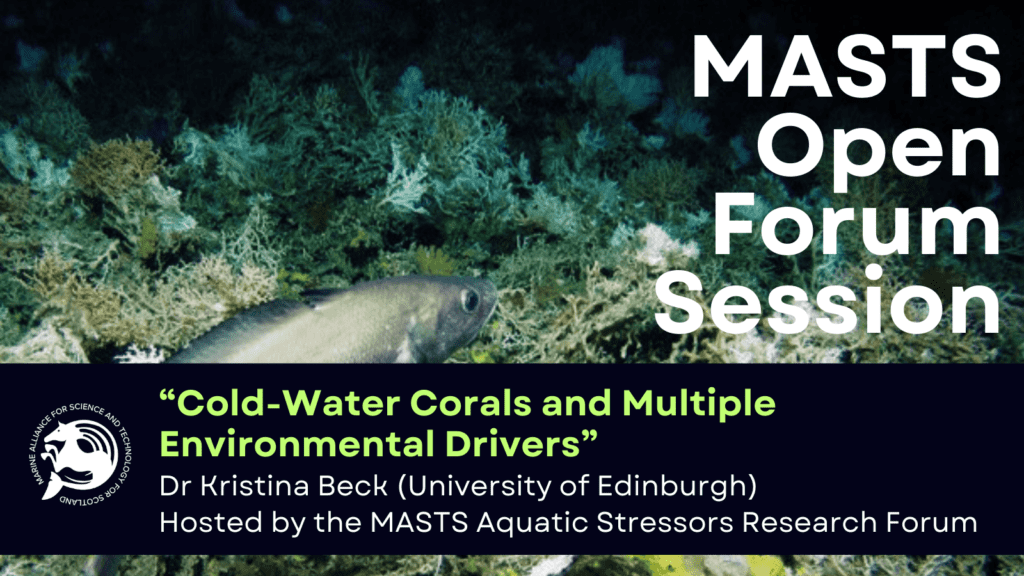
A recording of this session is available on the MASTS YouTube Channel! Dr Kristina Beck (University of Edinburgh) is describing the combined effect of certain environmental drivers on cold-water coral species.
Speaker: Dr Kristina Beck, University Teacher in Marine Science, University of Edinburgh
Some cold-water coral (CWC) species are important ecosystem engineer, forming complex three-dimensional reefs in the deep sea. These reefs consist of both live corals and dead skeletons and are associated with high biodiversity. However, CWCs are threatened by climate change. Previous laboratory studies mainly focused on the short-term effects of single environmental factors on adult CWCs, especially elevated temperatures and reduced pH. So far, little is known about the effects of reduced oxygen concentration and food availability on CWCs, the long-term and combined effect of all these environmental drivers as well as their effect on different life stages.
Therefore, I have conducted two long-term (6 and 12 months) aquarium experiments to investigate the combined effect of reduced pH, elevated temperature, reduced oxygen concentration and reduced food supply on three life stages of the solitary CWC Caryophyllia huinayensis and the colony-forming CWC Lophelia pertusa (syn. Desmophyllum pertusum). During the experiments, I have determined coral mortality, calcification, respiration, and energy reserves of live corals. I have also examined dissolution rates of dead L. pertusa skeletons under different ocean acidification scenarios using micro-computed tomography (µCT) to better predict how ocean acidification will affect the structural integrity of CWC reefs in the future. In both experiments, I have observed a delay in response, presumably because the effects only become visible once energy reserves are depleted, suggesting that short-term experiments overestimate coral resilience.
In the long-term, acidification alone had no effect on C. huinayensis, but warming and reduced food availability lowered their survival and calcification rates. The magnitude of change differed between life stages as calcification rates declined more in juvenile than in adult corals. Calcification rates of L. pertusa were lowest in the multiple driver treatments, reaching negative values after more than three months, presumably because the dissolution of skeletal parts not covered with tissue exceeded the growth rate of live polyps at aragonite undersaturation. In addition, the dissolution rate of dead coral skeletons increased with reduced seawater pH. Overall, the findings highlight the importance of considering interactive effects of multiple drivers, appropriate duration of experiments and potential ontogenetic differences when investigating CWC susceptibility to climate change. I also conclude that live CWCs may be able to cope with future environmental changes to a certain extent, whereas increased skeletal dissolution due to ocean acidification will lead to structural weakening of the dead skeletal framework and potential crumbling of CWC reefs in the long term.
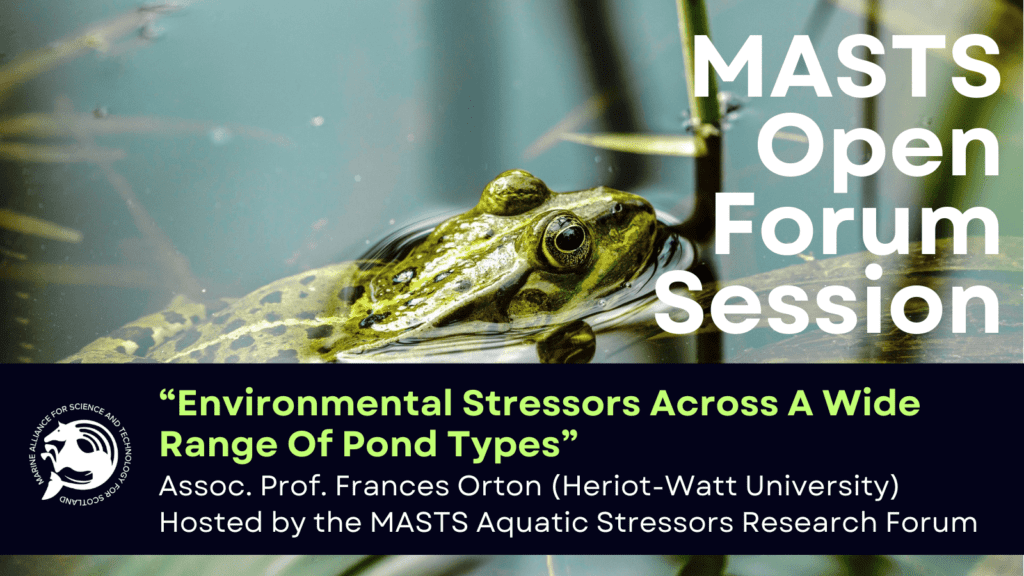
Dr Frances Orton (Heriot-Watt University) presented her study on small freshwater bodies, such as ponds, and the effect of six environmental stressors.
Speaker: Dr Frances Orton, School of Energy, Geoscience, Infrastructure and Society at Heriot-Watt University
Small freshwater bodies, such as ponds are likely to be subject to a wide range of environmental pressures due to their small water volume and proximity to anthropogenic structures. In our study, we sought to quantify intensity of six environmental stressors across these study ponds (n = 80): pollution (metals, pesticides, pharmaceuticals), eutrophication (nitrate/phosphate pollution), the presence of the invasive signal crayfish (Pacifasticus leniusculus: eDNA), heat wave occurrence/intensity, freshwater salinisation and the presence of Perkinsea infection.
The study encompassed isolated depressions, ditches, river floodplains, wet woodland, as well as urban and agricultural retention ponds, located in five geographical clusters in the UK: South-East England, East Anglia, South-West Scotland, Central-West Scotland and Central Belt Scotland.
Pond selection was based on estimated anthropogenic pressure and the presence of Rana temporaria, according to citizen science spawn count data. Predicted anthropogenic pressure levels based on publicly available data did not accurately predict measured levels of pollutions nor eutrophication. Eutrophication levels were generally low, however, we found high levels of organic pollutants across all ponds.
The MASTS ASM is a cross-disciplinary event that brings together the marine science community, with the aim of promoting and communicating research excellence and forging new collaborations. The event includes expert plenary speakers, general science and panel sessions, and e-posters.
Please see here for an overview of previous ASMs and programmes.
The Forum hosted a Special Session on “Multiple Stressors”, chaired by Forum Convenors Dr Frances Orton and Prof Karen Diele and hosted a total of 8 talks, a list of which can be seen below. The Forum also hosted a full-day Workshop “Designing multiple driver experiments” which was organised and led by Forum Steering Group members Prof Sinéad Collins and Dr Matt Wale.
Please see the full programme here.
Special Session Talks:
The Aquatic Stressors Forum hosted a Special Session on “Multiple Aquatic Stressors”. Please see below a list of the presented talks and take a look at the programme for more details.
Special Session Talks:
The Forum awarded 4 travel bursaries to representatives from Heriot-Watt University, the University of the West of Scotland, the University of Edinburgh and the University of Aberdeen.
Need an expert in an area related to aquatic stressors? Download the Forum’s database here or contact MASTS at masts@st-andrews.ac.uk
Environmental stressors include any physical, chemical or biological factor that negatively impact organisms at individual, population, community or ecosystem levels. The range of possible aquatic stressors encompass chemical (incl. oil and oilfield relates, nanoparticles, microplastics and litter), noise, electrical and light pollution as well as climate change-related parameters, such as water temperature, pH and salinity, furthermore fishery and changes in species interactions, such as predation and resource competition. Our knowledge of whether and how different stressors interact is minimal, which is a major obstacle to adequately considering multiple stressors in routine environmental risk assessments.
Associate Professor | School of Energy, Geoscience, Infrastructure and Society
Interests:
Professor of Marine Ecology | Head of the ENU Centre for Conservation and Restoration Science (CCRS)
Interests:
Dr | Zoology Lecturer
Interests:
Principal Research Fellow, Centre for Research into Ecological and Environmental Modelling (CREEM)
Interests:
Environmental Engineer
Interests:
Marine Directorate | Senior Environmental Toxicologist | Climate Change, Biodiversity and Ecosystems (CCBE) delivery area of the Science, Evidence, Data and Digital (SEDD) portfolio | Lead of the biological effects of contaminants work in CCBE
Interests:
Interests:
Associate Professor | Centre for Marine Biodiversity & Biotechnology | Institute for Life and Earth Sciences | School of Energy, Geoscience, Infrastructure and Society
Interests:
Lecturer in Life Sciences | School of Applied Sciences | Member of the Centre of Conservation and Restoration Science
Interests:
Lecturer in Aquatic Environmental Science
Interests:
Lecturer in Macroalgal Research
Interests:

Professor of Microbial Evolution
Interests:
We’re working behind the scenes to bring you a suite of useful, and updateable, resources including:
If you would like to be updated when the resources section is live please let us know.