This Forum provides a platform for knowledge exchange (information, education, networking), enabling the MASTS community to collaborate on Marine Climate Change. As a more holistic approach to studying marine climate change is needed to solve present issues this Forum engages researchers representing a variety of disciplines.
MASTS Research Forums and Working Groups form the major scientific driving force of the MASTS community. Working Groups (WG) provide opportunities for more focused Forum and cross-Forum activities, addressing specific time-bound challenges related to established or emerging areas of marine research, policy initiatives or regulation.
The Forum created this Working Group to inform action to adapt to climate change impacts in Scotland’s marine environment. This will be achieved by organising a science-policy engagement day and by fostering a dialogue among marine scientists, policymakers, practitioners, industry and nature conservation organisations, local authorities and NGOs. For more details please visit the MASTS Working Groups Webpage.

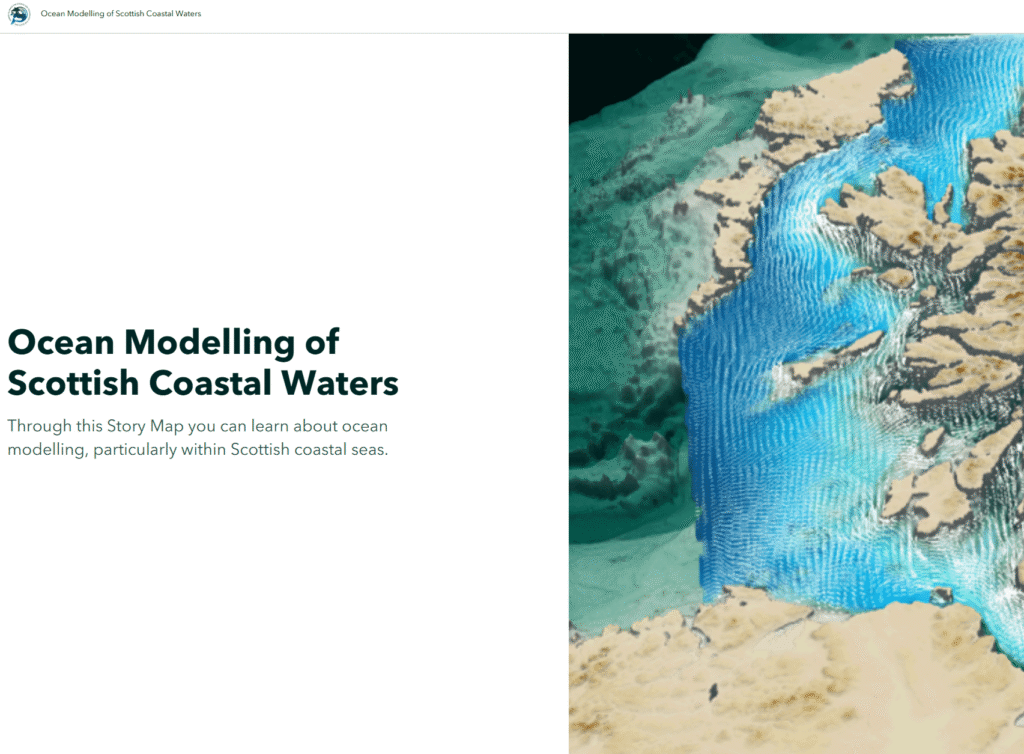
Members of the MASTS Marine Climate Change Forum supported this Working Group, initiated by the MASTS Deep Sea Forum, to create an interactive ArcGIS based Story Map and accompanying Policy Brief, to communicate the impacts of climate change on Scottish deep-sea ecosystems and their associated socio-economic impacts. For more details please visit the MASTS Working Groups Webpage.

MASTS Open Forum Sessions aim at connecting the MASTS community with its diverse Research Forums and Steering Groups. At these online sessions, Forums “open their doors” to present their members’ work, network with the community and exchange ideas on Forum objectives and activities.
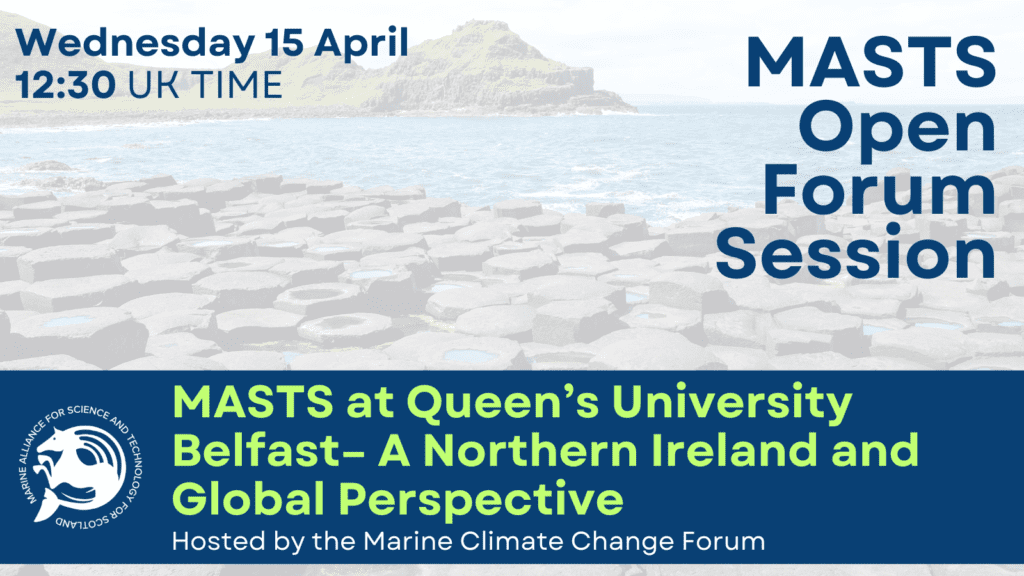
Presenter: Katrina Campbell (Queen’s University Belfast) presented about the marine and aquatic research taking place at Queen’s University Belfast. A recording of this session is available on the MASTS YouTube Channel.

A recording of this session is available on the MASTS YouTube Channel!
Speakers: Dr Heather Sugden and Dr Nova Mieszkowska, Newcastle University
Anthropogenic climate change has been re-shaping biogeographic patterns of species, causing shifts at all levels of ecosystem, alongside driving phenological changes. Such responses at all levels of biological organization are ultimately driven by temperature change, especially in marine invertebrate and macroalgae species. Within assemblages the composition and relative abundance of species with different thermal affinities are being re-sorted. Disturbance due to extreme weather events is superimposed upon these long-term patterns of response to climate. Greater amplitude and more frequent return times of extreme events are already occurring and predicted to accelerate, themselves being symptoms of climate change. Both extreme events and pervasive climate change will have direct effects on individuals and hence populations, with consequences for community structure and ecosystem functioning. This is especially so when the species affected are important foundation species and/or ecosystem engineers, dominating space and providing biogenic habitat for others, often by ameliorating environmental conditions. Historic records have helped to build a picture of intertidal rocky shore communities from the 1900s from several biogeographic areas when there was a groundswell of amateur naturalists. The MarClim project was conceived to bring together historical records across the biogeographic distribution of the UK regional seas and continue to monitor intertidal species taken from these records to track movements of key indicator species. Surveys track the abundance and distribution of 87 species of invertebrates and macroalgae at 100 sites around the UK Regional Seas and northern France on an annual basis. The project has recorded some of the fastest distributional shifts in leading and trailing range edges of species in any natural system and spans over half a century. Using these long-term data, alongside short-term observational and experimental studies provide an opportunity to investigate the impacts of short term change through extreme events, versus longer-term sustained shifts in species abundance and community composition.
(April 2025)
Speaker: Dr Johanne Vad, University of Edinburgh
Most of the United Kingdom’s deep sea (deeper than 200 m) is in Scottish waters. Scotland’s deep sea, is around four times bigger than Scotland itself and hosts a diverse range of habitats, such as submarine ridges, banks, seamounts, coral and sponge reefs, expansive soft sediments and sand waves. Biodiversity in these deep-sea habitats is extremely high but Scotland’s deep-sea ecosystems are threatened by human-induced climate change, pollution, and the extraction of fish and other resources. Deep-sea environments are generally less variable over short time scales than coastal ecosystems, making deep-sea species and habitats more sensitive to climate change impacts.
The MASTS Deep Sea Research Forum created a Working Group in 2024 to produce an interactive Story Map and accompanying Policy Brief to highlight main climate change drivers and case studies, as well as predictions of future scenarios and recommendations for policymakers and other stakeholders involved.
(April 2025)
The MASTS ASM is a cross-disciplinary event that brings together the marine science community, with the aim of promoting and communicating research excellence and forging new collaborations. The event includes expert plenary speakers, general science and panel sessions, and e-posters.
Please see here for an overview of previous ASMs and programmes.
The 2024 MASTS ASM offered a wide range of climate change related talks, some of the highlights are listed below. For a more comprehensive overview please click here.
The Forum organised a Special Session on “Climate Change”, chaired by Forum Convenor Dr. Bee Berx (Scottish Government), as well as a half-day Workshop titled “Impacts of climate change on marine coastal systems in Scotland to inform climate adaption”. Please see the full programme here.
The session contained 8 talks:
The latest climate change evidence update on storms and waves has now been published by MCCIP.
This update, led by Dr Lucy Bricheno, from the National Oceanography Centre in Liverpool, indicates that more very severe winter storms will cross over the UK and Ireland in the future.
The newest climate models are generally able to consistently predict storm tracks, showing an increase in large and intense wintertime storms and a greater likelihood of successive storms and compound events. High-impact and low-likelihood events, such as the collapse of the Atlantic Meridional Overturning Circulation (AMOC), could strengthen the storm track and winter westerly winds over the North Atlantic. The models also show that even a gradual weakening of the AMOC could lead to stronger storms and larger storm surges. However, it is important to note that there is still considerable uncertainty regarding future changes to North Atlantic storms, much of which are driven by natural variability rather than long-term climate change.
The key ‘takehome messages’ are summarised on the MCCIP storms and waves evidence review page, which also contains a link to the updated review paper.
This report describes a series of surveys of the biodiversity of rocky intertidal seashores around Scotland in September 2020, June to September 2021, and June to September 2022. The work builds on the ongoing MarClim (Marine Biodiversity and Climate Change) programme, started in 2002 and covering the coastlines of Great Britain and Ireland (to 2005) and parts of the Atlantic coasts of mainland Europe.
The Marine Climate Change Forum provides a focal point for climate change related research within the MASTS community in synergy with activities by the other MASTS research fora and themes.
The Scottish Government will continue to look to the scientific community to provide the necessary evidence to support climate change policies for adaptation and mitigation. The MASTS community also contributes already to the global knowledge base on the ocean’s role in the Earth’s climate, and climate change impacts, mitigation and adaptation.
These four main aims at their core are built on five common principles: (1) ensuring the MASTS community has opportunities to network, (2) communicating research within and beyond the MASTS community, (3) delivering tangible outputs, (4) amplifying –rather than duplicating– activities, and (5) being inclusive of all disciplines, career stages and organisations.
Visiting Lecturer | Marine Directorate Climate Change Lead | Environment Monitoring and Assessment Programme Oceanography Group | ICES Working Group on Oceanic Hydrography
Interests:
PhD Student | The Lyell Centre
Interests:
Lecturer
Interests:
Visiting Professor at RGU | Member of Board of Trustees at SAMS (Scottish Association For Marine Science)
Interests:
Director of Sediment Ecology Research Group (SERG) | Executive Director of MASTS
Interests:
Physical Oceanographer
Interests:
PhD Researcher
Interests:
International Centre for Island Technology, Orkney Campus
Interests:
Marine Biologust | Member of Board of Trustees at SAMS (Scottish Association For Marine Science)
Interests:
Food Security & Diagnostics | Institute for Global Food Security | School of Biological Sciences
Interests:
Marine Monitoring Manager
Interests:
MPA and PMF Manager
Interests:
Senior Lecturer in Marine Biology | Dove Marine Laboratory, School of Natural and Environmental Science
Interests:
Professor in Marine Ecology
Interests:
Senior Environmental Chemist | Climate change, biodiversity and ecosystems – Water Chemistry Group; OSPAR
Interests:
Unit Manager, Marine Ecology | SEPA representative on: Marine Climate Change Impacts Steering Group, BioDIG (Biodiversity Data and Information Group), Scottish Government NMP2 Consultation Authorities group and Scottish Sectoral Marine Plan Offshore Wind Energy Steering Group
Interests:
Fisheries Science Researcher
Interests:
Policy & Advice Manager (Coastal Ecology)
Interests:
PhD
Interests:
Palaeoceanography
Interests:

We’re working behind the scenes to bring you a suite of useful, and updateable, resources including:
If you would like to be updated when the resources section is live please let us know.