Marine Alliance for Science and Technology for Scotland

Biogeochemistry Forum

Welcome to the MASTS Marine Biogeochemistry Forum

This Forum provides an integrated platform for knowledge exchange (information, education, networking), enabling the MASTS community to collaborate on Marine Biogeochemistry Research.
The Forum ensures marine biogeochemists play a key role in shaping the future Scottish marine environment, promoting national as well as international biogeochemistry accessibility.

News & Events

Forum Activities

Joint MASTS – Challenger Conference

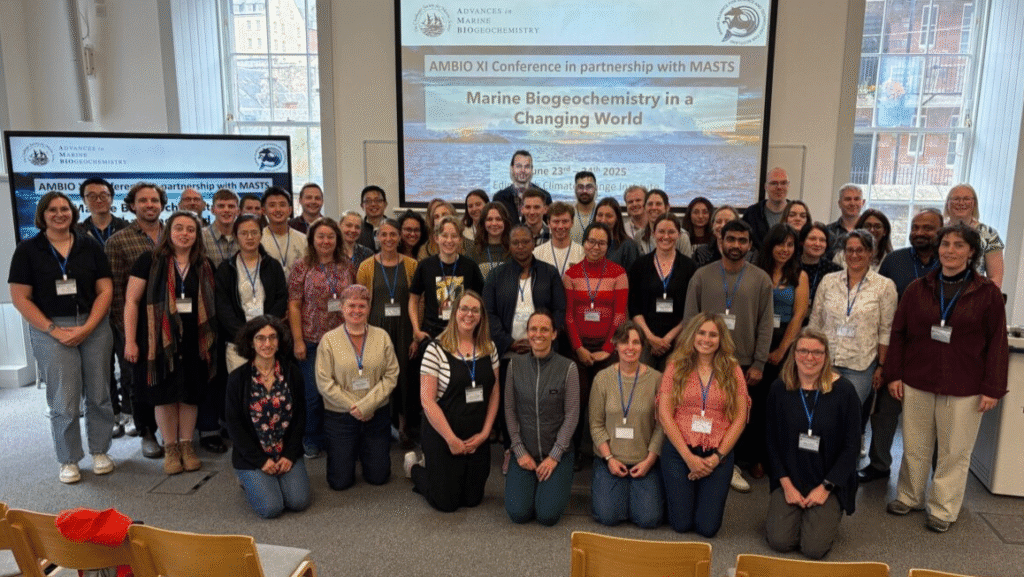
The Marine Biogeochemistry Forum joined forces with the Challenger Society to host “Advances in Marine Biogeochemistry (AMBIO)” conference. The event was held in June 2025 at the Edinburgh Climate Change Institute. A great two days of talks and sharing research findings.

AMBIO provides a technical forum for students, educators, researchers and governmental and industrial partners with shared interests in marine biogeochemistry.

Group of conference attendees smiling at the camera surrounded by large Power Point screens
Open Forum Sessions

MASTS Open Forum Sessions aim at connecting the MASTS community with its diverse Research Forums and Steering Groups. At these online sessions, Forums “open their doors” to present their members’ work, network with the community and exchange ideas on Forum objectives and activities.

Actionable and emerging blue carbon systems: from biogeochemistry to policy (2026)

Presenters: Martyn Jakins-Pollard (Cefas): UK Blue Carbon Evidence Partnership: Collaborative Evidence to Support Shared Policy Objectives. Ruth Parker (Cefas) – Assessing seabed carbon storage and sequestration (Blue Carbon): response to pressures and management interventions. Hannah Clilverd and Annette Burden (UK Centre for Hydrography) – Net-Zero Accounting for Blue Carbon: Enabling Saltmarsh Inclusion in National GHG Inventories.

A recording of these talks is here on the MASTS YouTube channel.

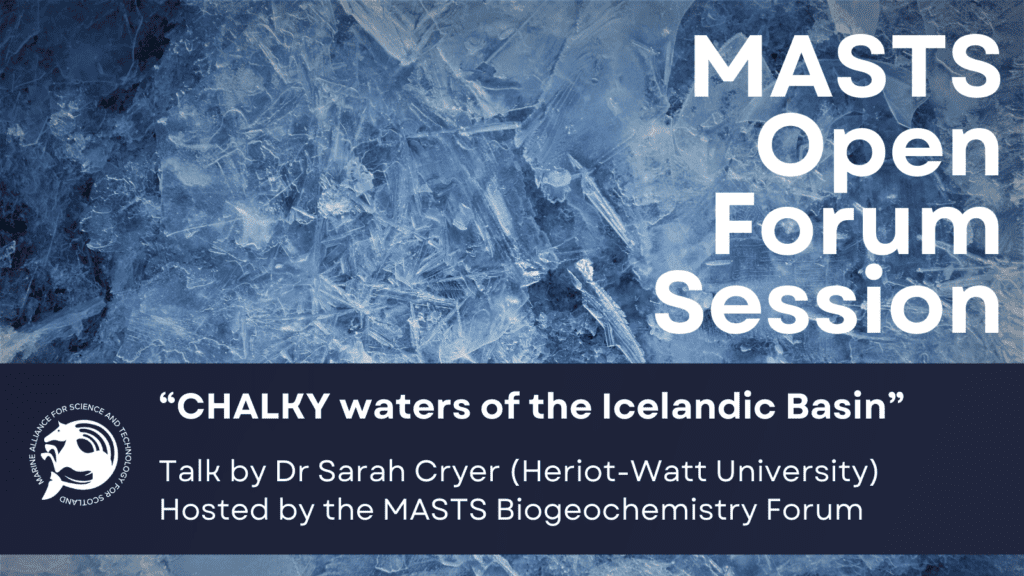
“Chalky waters and Blue Carbon” (2025)

Presenters and talks: Sarah Cryer (Heriot-Watt University) – HALKY waters od the Icelandic Basin; and Hugo Woodward-Rowe (University of Essex) – Determination of Blue Carbon accumulation rates in sediments impacted by anthropogenic pressure.

A recording of Talk 1 of this session is available on the MASTS YouTube Channel.

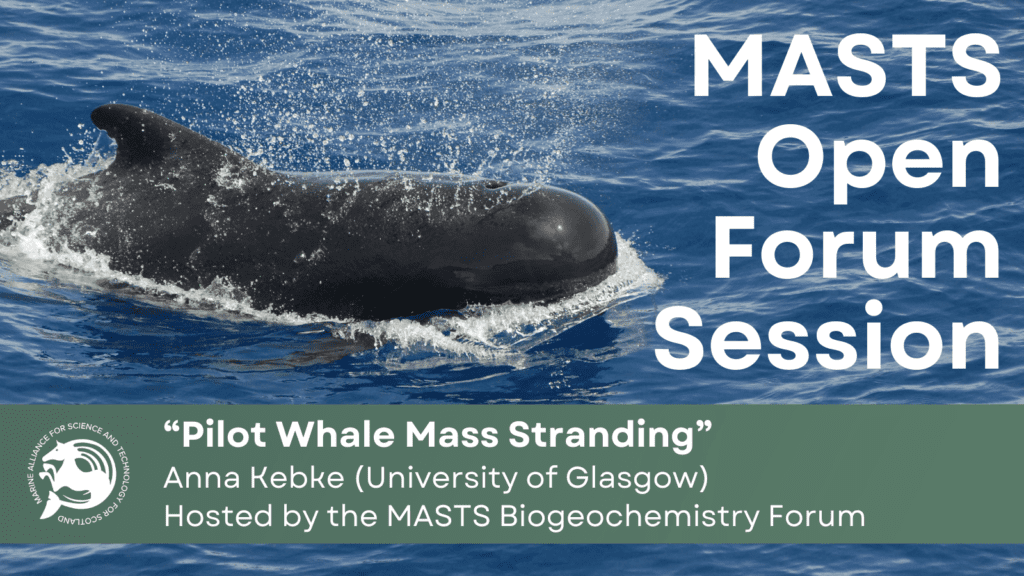
“Of Mass strandings and losing Nitrogen” (2024)

Speakers and talks: Anna Kebke (University of Glasgow) – Talk 1: “Test pilot: Using biomolecular proxies to identify physiological status and feeding history in a large pilot whale mass stranding event”; and Marta Santos Garcia PhD (SAGES; University of Edinburgh) – “Is The Ocean Losing Nitrogen?”

A recording of Talk 1 of this session is available on the MASTS YouTube Channel.

 MASTS Annual Science Meetings

The MASTS ASM is a cross-disciplinary event that brings together the marine science community, with the aim of promoting and communicating research excellence and forging new collaborations. The event includes expert plenary speakers, general science and panel sessions, and e-posters. Please see here for an overview of previous ASMs and programmes. 

The Forum chaired a Special Session on “Marine Biogeochemistry” with a total of 8 talks. Please see the full programme here.

List of talks:

  • Benjamin Gustafson (Heriot Watt University): “Recognizing biology in the ocean’s carbonate pump: Updating understanding of pelagic calcifier roles in production & export”
  • Chris Harrod (University of Glasgow): “Large-scale isotopic gradients in coastal marine environments complicate the reconstruction of ancient human diets in the arid Atacama coast of Chile”
  • Alex Houston (University of St Andrews): “Thermal Reactivity Predicts Bioavailability of Organic Carbon in Saltmarsh Soils”
  • Claire Powell (Centre for Ecology): “Ecosystem Service provision in the North Sea seabed: towards adopting natural capital approaches in subtidal benthic/sediment monitoring”
  • Philippa Rickard (Heriot-Watt University): “Exploring the organic composition of the Ocean’s surface and its relationship with air-sea gas exchange: Insights from the 30th Atlantic Meridional Transect.”
  • Marta Santos-García (University of Edinburgh): “Is the Arctic Ocean losing Nitrogen?”
  • Elinor Spencer (Heriot Watt University): “The effect of experimental technique on the elemental content of coccolithophores”
  • Hugo Woodward-Rowe (University of Essex: “Organic carbon mineralisation of disturbed anthropogenically impacted shelf sediments”

At the MASTS Annual Science Meeting 2023 in Glasgow the Forum gathered for the first time to introduce itself to the MASTS community and to look for interested members to join or provide input for Forum activities.

Please see the full programme here.

Forum Objectives

The Marine Biogeochemistry Forum (MBF) strives to ensure marine biogeochemists play a key role in shaping the future Scottish marine environment. Scottish marine biogeochemists are respected world-wide, and the MBF has facilitated consolidation of the Scottish marine biogeochemistry community by developing a united research strategy, with scientific excellence at its core. This is particularly important since a better understanding of biogeochemical processes and their sensitivity is required to evaluate their response to natural and anthropogenic change in the 21st Century and beyond.

Biogeochemistry is a key component of large national and international funding schemes and MBF research primarily addresses three environmental grand challenges: climate change and carbon cycling (including blue carbon and ocean acidification), open ocean biogeochemistry, and marine biomineralisation. In particular, the MBF has been pivotal in the formation of new initiatives including the role of nature-based solutions in mitigating climate change (e.g. The Scottish Blue Carbon Forum and industry-driven habitat restoration). Effective biogeochemistry frequently requires the parallel measurement of multiple processes, often over long-time scales via monitoring infrastructure. The critical mass of scientists and infrastructure within MASTS enables MBF to unify those resources, conducting high profile and high impact research of benefit to both society and science.

The Forum promotes international and national biogeochemistry accessibility, ensuring both international and within-MASTS interaction and impact, and facilitating common goals. Integration and communication are achieved using cross-cutting research agendas, themed workshops, meetings and social media.

  • Consolidate a critical mass of biogeochemists within MASTS, providing an opportunity to conduct key and high-profile impactful research
  • Promote and facilitate biogeochemistry accessibility across the MASTS Research Themes and Forums, ensuring within-MASTS interaction and impact, and facilitating common goals
  • Enable impact and knowledge exchange of MASTS MBF outputs by directly engaging with a range of stakeholders across the policy, industrial and public sectors
  • Provision of student and researcher support to accelerate biogeochemical advances

Forum Steering Group

Forum Convenor:
Alex Poulton (
Heriot-Watt University)

Biological Oceanography

Interests:

  • Marine Ecology
  • Global plankton ecology
  • Aquatic Biogeochemistry
  • Linkages between diversity, primary production, bio-mineralisation, nutrient recycling
Forum Convenor:
Robyn Tuerena
(SAMS/Scottish Association for Marine Science)

Lecturer in Nutrient Biogeochemistry

Interests:

  • Nutrient and carbon cycling on local to basin scales and their interactions with phytoplankton and marine food webs
  • Nutrient concentrations, stable isotope techniques, stoichiometric tools
Anna Belcher (UK Centre for Ecology & Hydrology)

Catchment Biogeochemist | Aquatic Ecosystems Group

Interests:

  • Aquatic biogeochemistry
  • Role of ecosystems on carbon cycling in aquatic systems
  • Marine/freshwater interface
  • Terrestrial carbon fluxes
  • Observational science
Claire Powell (Cefas/Centre for Environment, Fisheries and Aquaculture Science)

Sediment Biogeochemist

Interests:

  • Oceanography
  • Geochemistry, Atmospheric Chemistry, Environmental Chemistry
  • ‘Benthic pH gradients across a range of shelf sea sediment types linked to sediment characteristics and seasonal variability’
David Paterson (University of St Andrews)

Director of Sediment Ecology Research Group (SERG) | Executive Director of MASTS

Interests:

  • Ecology and dynamics of marine systems with a strong focus on the “biodiversity-ecosystem function” debate and the dynamics of marine microbiota
  • Climate change research including the combined effects of temperature and CO2 on system response
  • Interdisciplinary studies of “biogenic stabilisation” by microbes and microphytobenthos, through the extracellular polymers produced by biofilms that increase the critical threshold for sediment re-suspension
Elis Jones (Konrad Lorenz Institute for Evolution & Cognition Research, Austria)
Hugo Woodward-Rowe (University of Essex)

PhD student

Interests:

  • Carbon stored in shelf sediment surrounding man-made structures
  • Marine Biology and Marine Environmental Management
Julie Hope (University of St Andrews)

Lecturer in Marine Biology

Interests:

  • Coastal benthic ecosystems, bio-physical and biogeochemical interactions and ecosystem function in a changing world
  • Sediment-biota interactions, benthic ecology and changes to benthic communities and ecosystem function due to anthropogenic stressors
Laetitia Pichevin (University of Edinburgh)

Senior Researcher in Marine Biogeochemistry | ICP Facility Manager

Interests:

  • Past changes in marine nutrient cycling, in particular N, Si and Fe.
  • Impact of Global Change on today’s marine nutrient cycles
  • Marine oxygen changes from recent to deep time
  • Mass spectrometry (manager of the ICPMS facility at University of Edinburgh)
Marta Maria Cecchetto (Stazione Zoologica Anton Dohrn, Italy)

Postdoctoral Research Associate | Stazione Zoologica Anton Dohrn | Genova Marine Centre, EMI Department

Interests:

  • Stable Isotope Ecology
  • Benthic Ecosystem Functioning
  • Deep Sea Ecology
  • Intertidal Ecology
  • Geomorphology
  • Seagrass Ecology


Projects:

The AMMIRARE project aims to enhance the resilience of Mediterranean coastal systems to climate change through Nature-based Solutions (NbS). It tackles coastal erosion, sediment loss, and beach degradation by combining pilot actions, ecological restoration, and innovative monitoring tools. The project integrates applied research with sustainable coastal governance to support adaptive management. Pilot sites span five regions in Italy and France, involving diverse local stakeholders.
 

Marta Santos Garcia (University of Edinburgh)

Final year PhD student (2022-2026)

Interests:

  • Marine biogeochemistry with a focus on nitrogen cycling
  • Impacts of global change on the biogeochemistry of polar oceans
  • Application of stable isotopes, stoichiometric and inverse modelling approaches to study nutrient dynamics from local to basin scales
Natalie Hicks (University of Essex)

Senior Lecturer | Benthic Biogeochemist

Interests:

  • Coastal to offshore sedimentary habitats, particularly focusing on carbon cycling (blue carbon, carbon dynamics, carbon burial and sequestration
  • Understanding processes on sediments or seabed
  • Role of coastal habitats (salt marshes, seagrass meadows, intertidal mudflats, estuaries) in mitigating climate change through carbon uptake and storage, but also how this links to coastal defence, flood protection, enhancing biodiversity, improved water quality and pollutant remediation
Pablo Trucco Pignata (NOC/National Oceanography Centre)
Philippa Rickard (Heriot-Watt University)

Dr | Post Doctoral Research Associate | The Lyell Centre | Carbon-Water Dynamics Research Group | SOLAS UK National Representative and SOLAS Europe Panel member

Interests:

  • Spatiotemporal variability and functioning of the sea-surface microlayer
  • Controls of air-sea gas exchange
  • Drivers of organic matter composition in surface waters


Projects: 

  • Breathing Oceans: understanding the organic skin that modulates the exchange of greenhouse gases between the atmosphere and the ocean (BOOGIE)
  • Enhancing coastal protection, biodiversity and ecosystem services through better knowledge and local engagement in mangrove rehabilitation (ENHANCES)
Rachael Hall (SAMS/Scottish Association for Marine Science)

PhD

Interests:

  • Benthic ecology and biogeochemistry
  • Anthropogenic impacts on blue carbon ecosystem functioning
  • Stable isotope ecology
Sarah Cryer (Heriot-Watt University)

Dr | Post Doctoral Research Associate | The Lyell Centre | Ocean Biogeochemistry CHALKY Project | OceanCANDY Group

Interests:

  • Carbonate Chemistry
  • Ocean Acidification
  • Primary Production
  • Bio-mineralisation
  • Autonomy
Secret Link
MASTS Resources

We’re working behind the scenes to bring you a suite of useful, and updateable, resources including: 

  • Find an expert
  • Find facilities & equipment
  • MASTS Publications


If you would like to be updated when the resources section is live please let us know.